
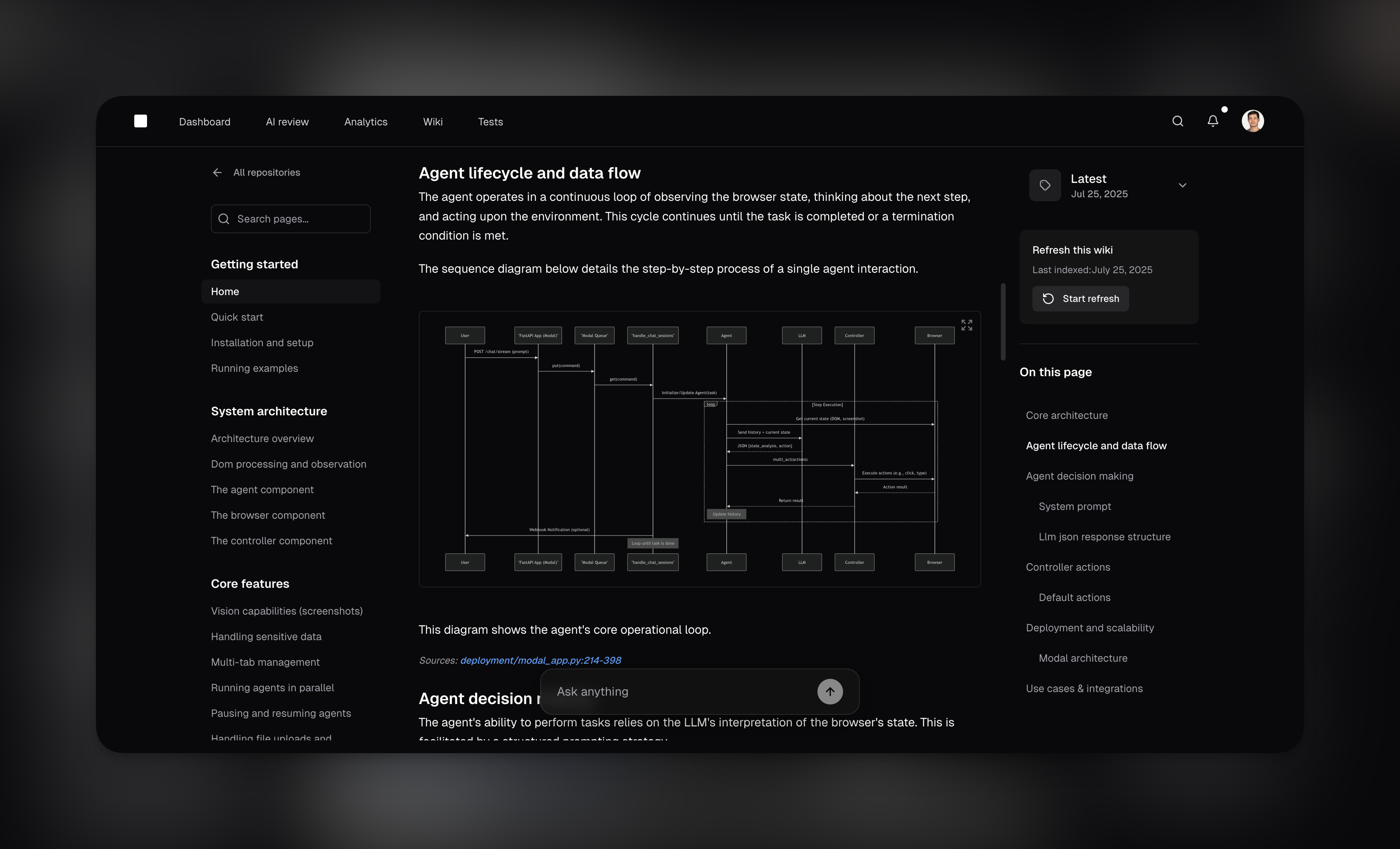
Getting started
1
Navigate to Wiki
Go to cubic.dev/wiki or click Wiki in the main navigation.
2
Generate documentation
Select a repository and click Generate. Public repositories can generate wikis on the free
plan. Private repositories require a paid plan. cubic analyzes your codebase and creates
documentation in about 3 minutes.
3
Search and explore
Browse the documentation or ask questions in natural language to get instant answers.
Auto-refresh
Keep your wiki documentation automatically up to date without manual intervention. When enabled, cubic periodically regenerates your wiki to reflect the latest code changes. Scheduled auto-refresh is available on paid plans. On Team, wikis refresh monthly. On Pro and Max, you can choose daily, weekly, or monthly. Public repositories can still be refreshed manually on the free plan, while private repository generation and refresh require a paid plan.Repo sync
Bring the wiki to where your team and coding agents already work: your repository. When enabled, cubic exports the wiki as markdown files into a directory in your repo (default.cubic/wiki) and keeps them current through a rolling pull request.
Each export contains one markdown file per wiki page organized by section, an index.md table of contents, and an AGENTS.md entry point so coding agents like Claude Code and Cursor can discover and use your docs without any extra setup.
To enable it, open your wiki and turn on Repo sync on the wiki card. Confirm the target directory, and cubic opens a pull request from the cubic/wiki-sync branch. From then on:
- Every wiki refresh, scheduled or manual, updates the same rolling PR — merge it whenever you want the repo copy updated
- If the wiki content didn’t change, cubic skips the commit, so there’s no PR churn
- Use Sync to repo now from the wiki card’s ••• menu to trigger a sync manually
- Sync status — including a link to the open PR — shows directly on the wiki card
Custom instructions
Add custom instructions to guide how your wiki is generated (for example, “Focus on API docs” or “Write for beginners”). Open the ••• menu on a wiki and choose Custom instructions. Instructions are saved per repository and applied on the next regeneration. Custom instructions are capped at 10,000 characters.Wiki MCP
Your wiki is available through cubic’s MCP server. Connect Claude Code, Cursor, Windsurf, or any MCP-compatible tool and your AI assistant can query your wiki directly while you code. This is especially useful when working across multiple repositories. Your AI agent can pull documentation from any repo’s wiki without you leaving your editor.Asking questions
Ask questions about your codebase in plain English and get comprehensive answers with code references. You can even request visual diagrams to better understand complex architectures and flows.Chat best practices
- Do's ✓
- Don'ts ✗
- Be specific - “How does the OAuth2 refresh token work?”
- Include context - “In the checkout flow, how are payments processed?”
- Request visual outputs - “Show me a diagram of the authentication flow”
- Ask for examples - “Show me examples of error handling”
Sharing answers
Every search generates a shareable URL. Share the link with teammates. Anyone in your GitHub organization with repository access can view it.Frequently asked questions
Does generating or refreshing a wiki consume my reviewed lines?
Does generating or refreshing a wiki consume my reviewed lines?
No. Wiki generation and refreshes have separate limits and do not consume your GitHub PR
reviewed-line allowance. See AI review usage.
How does auto-refresh work?
How does auto-refresh work?
When enabled, cubic automatically regenerates your wiki on your chosen schedule. This runs in
the background, so your documentation stays current without any manual effort. Scheduled
auto-refresh requires an active paid subscription. On Team, wikis refresh monthly. On Pro and
Max, you can choose daily, weekly, or monthly. Public repositories can still be refreshed
manually on the free plan.
Does Wiki work with private repositories?
Does Wiki work with private repositories?
Yes. Wiki works with both public and private repositories, and access still follows GitHub
permissions. Public repositories can generate and refresh wikis on the free plan. Private
repositories require a paid plan for generation and refresh.
Who benefits most from Wiki?
Who benefits most from Wiki?
Wiki is especially valuable for new team members getting up to speed, customer success teams
understanding product architecture, and anyone who needs to navigate unfamiliar codebases
quickly. It eliminates the need to hunt through code or rely on tribal knowledge.
How do I replace a private repository wiki?
How do I replace a private repository wiki?
Private wiki slots can be reassigned 90 days after the wiki’s first successful generation. To
reuse a slot, open the wiki’s ••• menu and delete the wiki. Deleting it on or after day 90 frees
the slot immediately. If you delete it earlier, the slot remains reserved until the original
90-day period ends.Wikis do not expire automatically. Refreshing a wiki or disabling auto-refresh does not reset
the 90-day period or free its slot.