
Free plan
The free plan includes 20 AI reviews per month, shared across repositories in your GitHub organization. The quota resets on the 1st of each month. Review comments show how many reviews remain.Paid subscriptions
For paid AI review access, cubic’s subscription cost is determined by the number of developer seats you choose to activate. Each active seat corresponds to a unique GitHub user within your organization. AI review usage on paid plans is measured in reviewed lines, with an allowance per paid seat that is pooled across your team.- Seat-based billing: You are billed based on the number of active seats you assign to your team members (GitHub users).
- Flexible seat management: You can manage seat assignments at any time, both during your free trial and after it ends.
- Customizable checkout: When you purchase a subscription, you select the exact number of seats you need.
- Ultrareview: Paid and trial plans include Ultrareview for high-risk or complex PRs. Ultrareviews count toward your team’s reviewed-lines allowance at 3× the standard rate.
- Seat and billing management: Assign seats in Settings → Members. Change your plan, seat count, and payment details in Settings → Billing.
Seat scope across organizations
Seat assignments are scoped to the selected GitHub organization. If your company uses cubic in multiple GitHub organizations, assigning a seat in one organization does not automatically assign that user a seat in another organization. The seat summary in Settings → Members applies to the selected organization. For example,86 of 155 paid seats in use means that organization has 86 active developer seats out of 155 paid seats. Other linked organizations do not consume that organization’s available seats.
Usage and flex capacity
See AI review usage and limits for what counts toward your allowance. Other features, such as local reviews and coding agents, have separate limits. Enable flex capacity on a paid plan to buy extra reviewed lines when the included allowance runs out. An admin sets the monthly spend limit in Settings → Billing.Assigning seats
To manage seats as an admin, go to Settings → Members:- Turn on a developer’s Seat switch to assign a seat, or turn it off to unassign one. cubic asks you to confirm each change.
- When every paid seat is in use, turning a seat on buys another seat, prorated. If more people already have seats than you pay for, it buys enough seats to cover them too. cubic shows the price before you confirm.
- Turning a seat off does not lower your bill. You keep paying for your seat count until you lower it with Change on the seats row in Settings → Billing.
Automatic seat management
Turn on Give new developers a seat automatically in Settings → Members to give a seat to each developer who joins your GitHub organization or opens their first PR, and to remove seats when members leave. When every paid seat is in use, cubic buys another seat, prorated. When someone with a seat leaves your GitHub organization, cubic also lowers your paid seat count, unlike turning a seat off yourself. These changes affect billing. With Vercel billing, a developer’s first PR doesn’t give them a seat. An admin turns their Seat switch on, and you add paid seats in your Vercel dashboard. Existing manual assignments remain. For example, if 3 of 10 developers have seats, turning it on gives a seat to the next new developer who opens a PR, bringing the assigned total to 4. It does not assign the other existing members.Bot seat management
cubic creates a separate bot row when a recognized bot, such asdevin-ai-integration[bot], first opens a PR. Bot reviews are disabled by default;
an admin can turn on Review PRs for a bot in the bots group at the bottom of
Settings → Members. When a bot with reviews turned off opens PRs, a card on that page
suggests turning them on.
Enabled bots do not require paid developer seats. Their reviews consume the team’s
shared reviewed-line allowance.
Frequently asked questions
Why do Pro and Max require more seats than I enabled?
Why do Pro and Max require more seats than I enabled?
Pro and Max require a seat for each active developer in the installation, including developers
whose seat toggle is off. Active means opening at least 15 PRs in the last 30 days. Bots are
excluded. This minimum applies because codebase scans on Pro and Max cover the whole repository.
Team does not have this activity-based minimum.
Do I have to pay for everyone imported during the trial?
Do I have to pay for everyone imported during the trial?
No. Everyone is enabled during the trial so your team can try cubic. Before upgrading, go to
Settings → Members and turn off the Seat switch for users who do not need seats.
Choose your paid seat count at checkout. Pro and Max still require enough seats to cover the
active-developer minimum.
I paid through Vercel. Why does cubic still show a trial or free plan?
I paid through Vercel. Why does cubic still show a trial or free plan?
Check that you’re viewing the GitHub organization linked to your cubic integration in Vercel. A
subscription linked to your personal GitHub installation does not automatically cover a separate
organization. If the wrong installation is linked, contact support with the
organization name and your Vercel subscription details so we can help correct the connection.
Is there an annual plan?
Is there an annual plan?
Yes. We offer an annual subscription at a 20% discount off the monthly rate. Select “12 months”
on the checkout page, and the discount will apply automatically.
Where can I apply a coupon code?
Where can I apply a coupon code?
You can enter your coupon or promo code on the subscription checkout screen: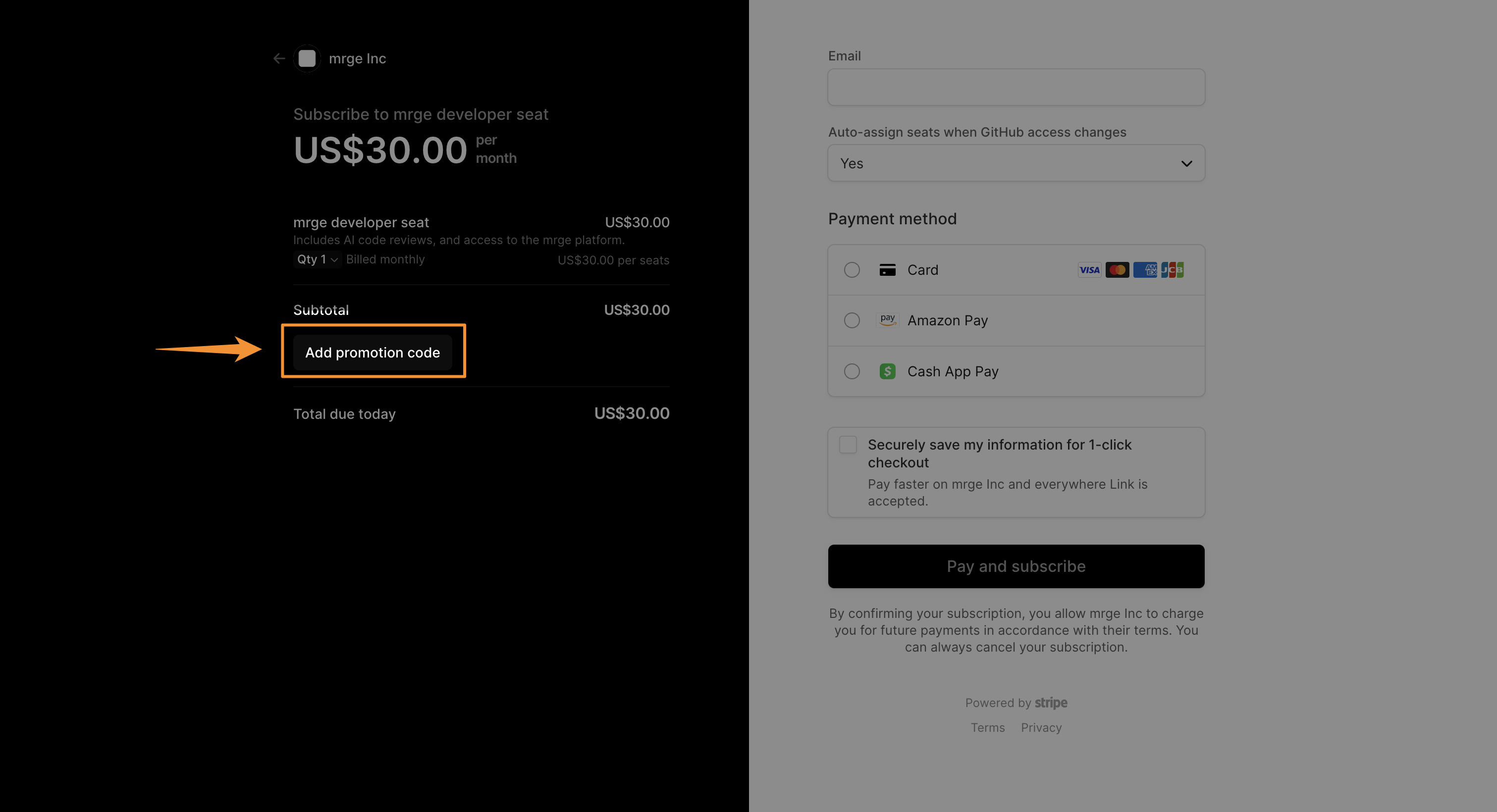
Can I cancel my plan at any time?
Can I cancel my plan at any time?
You can cancel your subscription at any time: in Settings → Billing, select Manage next
to your payment method to open the billing portal.
You’ll keep full access until the end of your current billing period; after that you won’t be
billed again.
How do I upgrade or downgrade seats mid-cycle?
How do I upgrade or downgrade seats mid-cycle?
To change your seat count after your subscription has started, go to Settings →
Billing and click Change on the seats row. Prorated
charges or credits will be applied based on your changes.
What payment methods do you accept?
What payment methods do you accept?
We currently accept all major credit cards (Visa, MasterCard, American Express) and PayPal. For
enterprise customers, we also support ACH bank transfers. Contact support to set them up.
Do you offer discounts for nonprofits or educational institutions?
Do you offer discounts for nonprofits or educational institutions?
Nonprofits and schools can receive a 50% discount. Please contact
support to verify your eligibility.
Do you offer free plans for open source projects?
Do you offer free plans for open source projects?
Yes. Public repositories on the free plan use a separate public fair-use allowance. On paid
plans, reviews of public PRs from workspace members count toward the team’s reviewed-line
allowance; reviews from external contributors do not. See public-repository
usage for details.
How do I delete my account or disconnect GitHub?
How do I delete my account or disconnect GitHub?
Cancelling a subscription, disconnecting GitHub, and deleting your account are separate actions.
See the Support FAQ for each one.